Envisioning the Future Through a Reimagined Past
In the spring of 2026, Operation EPIC FURY revealed two juxtaposing truths of American military power in the Middle East. The region’s ever-changing security landscape still requires a steady presence[i], but significant basing in such a dynamic environment necessitates strategic re-evaluation[ii]. Ironically, this juxtaposition is exactly where the United States Space Force, the branch in charge of securing American interests in the space domain, receives a unique advantage. While it would be unwise for the U.S. Navy to rely on Bahrainis to operate its Naval 5th Fleet or for the Air Force to delegate its Al Udeid fighter wings to the Qataris, the Space Force can absolutely cooperate with Middle Eastern partner nations to assist with space operations[iii]. With concrete data security in place, an on-the-ground Space Force presence in contested regions could be almost completely replaced by trusted host nations in a way no other military service can afford–USSPACECOM’s progressing multi-national orbital warfare plans[iv] and the Joint Commercial Operations (JCO)’s global operations floors prove this pointxiv.
The crux of Space Force’s unique advantage is three-fold: the Space Force must partner with a space-interested nation who, firstly, maintains a military and geographic position that provides strategic utility; secondly, with which a track-record of cooperation and strategic alignment is ensured; and third, whose private and public sectors have the strategic capacity for engagement. Whether it be joint ground station development with key Middle Eastern allies or the evolution of an in-theater asset to support the Space Surveillance Network, partner force integration is imperative to the Space Force and international investment is the avenue of success.
Partner To Win
The Space Force is going all in on next-generation proliferated Low Earth Orbit (pLEO) systems[v]. Betting that these new constellations will provide unmatched mission resiliency, global access, and security to the Joint Force, the nation’s youngest military service plans to soon provide overwhelming advantage to commanders in every combat domain. However, pLEO systems such as those outlined in General Chance Saltzman’s Objective Force[vi] strategy will impose an outsized reliance on international partnership.
Further, as the Space Force unleashes these novel systems, new risks emerge. The rapid growth of commercial space activity is increasing orbital debris[vii], holding critical American and allied satellite constellations at greater risk. Persistent space surveillance radar gaps such as that in the Middle East[viii] limit the Space Force’s ability to maintain assured access to space. In the diplomatic sphere, initiatives like the PRC’s Space Silk Road[ix] threaten American partnerships across the globe, further complicating efforts to close critical gaps. However, by pairing opportunities presented on the strategic battlefield with a smart partnership investment strategy, the Space Force can overcome these challenges to achieve its main objectives.
Armor Department of War Communications for the Future
American satellite communications (SATCOM) systems have historically nested in the Geosynchronous Orbit (GEO) Belt, where physics play to their advantage. Inconceivably large satellite footprints enabled victory in the initial phases of the Iraq War[x] and fueled American diplomacy, as space-based communication nodes provided critical partners like Hamid Karzai access to remote Afghan governorates in turmoil[xi]. Although these traditional space platforms offer some crucial advantages, ultra-secure, cost-effective pLEO constellations such as StarShield[xii] and SDN[xiii] are the way of the future. To unlock these systems’ most powerful advantages, the Space Force must implement a globe-spanning terrestrial network with an exponentially larger density than what currently services America’s GEO satellites[xiv]. This isn’t a financial or developmental burden the Space Force should carry in isolation[xv]. Instead, the Space Force should prioritize international partnership to harness strategic opportunity and future-proof America’s space-enabled Joint Force.
When compared to Low Earth Orbit systems, traditional GEO-based satellites do retain one advantage. Because of their location tens of thousands of miles overhead, a single geosynchronous satellite can view up to one third of Earth’s surface at a time. This ultimate high ground enables real-time communications fast enough to command an aircraft from across the world[xvi] with only a handful of ground stations in Europe and the Pacific. Conversely, pLEO constellations, flying much closer to Earth, require tens–if not hundreds–of ground stations to compensate for their small field of view[xvii]. Current pLEO constellations are also restricted on the number of intersatellite links they can support[xviii], limiting their ability to adapt to changing environments and exposing users to connection failure.
Understanding these challenges from its earliest stages, Starlink, the most proliferated pLEO SATCOM constellation in the world, operates from over 150 ground stations across the globe to overcome these obstacles and guarantee low latency for its customers[xx], [xxi]. As a global organization, the Department of War must build a similarly robust terrestrial network to defend new constellations from space-affecting adversaries.
While the Space Force could invest in these ground networks alone, the fulcrum of this architecture’s operation should be smart partnership with our allies’ space programs to ensure strategic success, thwart adversary advances, and ensure the burden of developing these whole-of-force systems isn’t laid solely on the United States.
Collapse CENTOM’s Space Surveillance Black Hole
Charged with space launch and re-entry detection[xxii], the U.S. Space Surveillance Network (SSN) utilizes ground- and space-based sensors to survey the world for new space launches, watch for long-range intercontinental ballistic missiles, and track on-orbit objects for unsafe activity. Operated by the Space Force’s 18th and 19th Space Defense Squadrons, the SSN is a shining example of how the Space Force works as a global partner to protect access to space for all nations[xxiii]. However, the SSN is currently limited in its reach.
The SSN employs several types of sensors, but its early warning and space launch missions rely heavily on colossal phased-array radars[xxiv] capable of tracking objects three thousand miles[xxv] beyond the horizon. A closer look at the locations and capabilities of these systems, however, reveals a critical gap—one that will become increasingly consequential for the future of spaceflight in the Middle East.
The nearest radar capable of detecting missile launches and space collisions over the region stands at RAF Fylingdales in the United Kingdom29. Nearly 2,900 miles away from Fylingdales lie Iran’s principal space launch centers Shahrud and Semnan[xxvi], where the Islamic Revolutionary Guard Corps launches military satellites in coordination with the Iranian Space Agency. At such distances, Fylingdales would detect a launch from Iran minutes after liftoff—an eternity in missile warning terms and too late to reliably track space launches.
The coverage gap grows even more pronounced farther south. On the Arabian Peninsula, construction continues at the Etlaq Spaceport[xxvii], where Oman is building the world’s second most advantageous launch site by latitude and rotational velocity32, a distinction that could propel the Arabian Peninsula into global prominence as a premier space launch location. Nearly 3,900 miles away from Etlaq sits RAF Fylingdales—almost 900 miles beyond the radar’s maximum range.
Yet geometry is unforgiving. Accounting for Iran’s primary launch locations, the likely launch azimuth from Etlaq, and the curvature of the Earth itself, it becomes clear that Fylingdales effectively has no visibility of launches from either Iran or Oman. In practical terms, some of the Space Force’s most capable radars are blind to Iran’s principal launch complex and to what may soon become one of the most active spaceports in the world.
In space, what a nation cannot see, it cannot secure—and today, one of the world’s fastest-growing launch regions sits squarely in America’s blind spot. Partnering with nations in the Middle East to close this critical gap is essential to preventing catastrophe on orbit and strategic surprise on the ground.
Unravel the Space Silk Road
China’s Space Silk Road is threatening key American alliances with space developed Middle Eastern partners. Initially announced as an academic venture with the Chinese University of Hong Kong[xxviii], the Space Silk Road seeks to expand China’s greater B&R Initiative into the space domain by offering Middle East and African nations partnership on high-tech satellite payloads and development facilities, ride-shares aboard Chinese spacecraft, and export of military-grade space systems like BeiDou. China has utilized its greater Space Silk Road initiative to establish itself as the preferred space partner for some of the Middle East and Africa’s most space-developed nations.
In the Middle Eastern theater, China has seen its most success in Pakistan and Egypt. The People’s Republic of China has developed 100 percent of Pakistan’s indigenous communication satellites and launched all of its earth observation satellites[xxix], establishing China as Pakistan’s de facto space access partner. Even further, Pakistan’s military was selected as the first nation in the world to receive military-grade precision data from BeiDou navigation satellites[xxx] and has allowed China to maintain a BeiDou ground station in Karachi and at Pakistan’s space agency headquarters[xxxi]. Egypt has also partnered with the Chinese government and private firms to develop next-gen earth observation and testing satellites[xxxii], notably the secretive Horus series[xxxiii] and MisrSat 2, a joint project between the Chinese National Space Agency and EgSA[xxxiv], the Egyptian Space Agency.
Although China has been asserting its space initiatives in the Middle East, the United States has seen some success in deterring Chinese investment. In 2024, the United States warned the UAE from participating in CNSA’s Chang’e 7 Lunar Mission, citing concerns that American defense-related technology aboard the UAE’s Rashid II rover could be shared with China[xxxv]. In response, the UAE joined Firefly’s Blue Ghost mission to the far side of the moon, safeguarding American tech while enabling the UAE to continue space pursuit[xxxvi]. This intervention marks the most significant American blockage of Chinese space expansion to date and sends a signal to the rest of the space-expanding Middle East that a single partner must be chosen; double-dipping is not permitted. As China advertises systems like BeiDou on the international military market, the U.S. Space Force should be postured to do the same—presenting the threats of a Chinese-dominated space architecture while incentivizing use of American systems like GPS.
Reaching orbit is a decades-long endeavor. As Middle Eastern nations begin their ascent to space, the partner that stands with them at the outset will likely be the one that remains beside them for the journey ahead. If the United States hopes to be that partner—carrying the region to Low Earth Orbit and beyond—it must engage now, before China secures the role.
Select the Right Investments
Finite Space Force resources give us the opportunity to think, work, and partner smarter to strategically prioritize our investments. For example, investment in a country without a time-tested interest in space could be risky as the volatility of high-tech investment and failure on the launch pad sway interest. A rock-solid investment plan should account for these considerations but also leave room for burgeoning nations still learning to launch. By implementing a three-tiered investment framework, the Space Force can purposely build its partnerships, laying the foundations for decades-long alliances and diamond-strength mission-sets.
Country Ranking Methodology
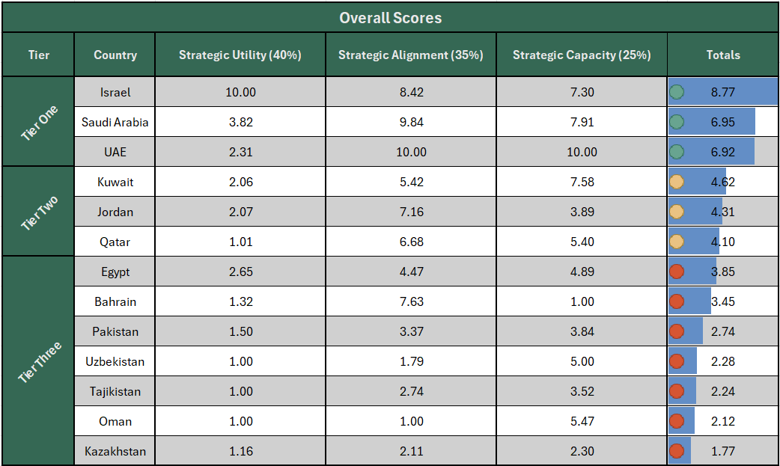
The Sand to Stars Framework implements characterizing metrics to identify the Middle East’s most space-developed nations and uncover future Space Force partners. Ranking criteria are grouped and scored uniquely according to three categories. First, to evaluate a specific nation’s strategic utility to the United States, a measure of geography and infrastructure as it relates to the ground, link and space segments of the domain is recorded. Next, national strategic capacity is measured by the depth of its short-, medium-, and long-term economic metrics. Finally, an investigation into the quality of engagement with CENTCOM and Middle Eastern military and diplomatic initiatives informs strategic alignment. A final overall score indicates Israel, Saudi Arabia, and UAE as the highest-potential space partners and Oman, Kazakhstan, and Pakistan are among the lowest.
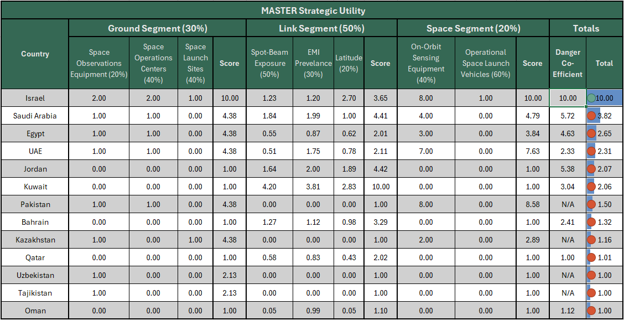
Strategic Utility - 40% Weight.
● Strategic Utility defines how postured a country is to support military space operations. Measured by the level of sophistication in the ground, link, and space segments, Strategic Utility effectively maps which countries are most ripe for military-to-military partnership. Once each nation’s categories are finalized, a Danger Co-efficient is applied with a 30:70 weighting ratio, emphasizing the value of force protection over strategic utility. Points are granted on a 1-10 scale as a summation of all categories.
o Ground Segment – 30% weight. This category measures the prevalence of space observations equipment (20% weight), space operations equipment (40% weight), and space launch sites (40% weight).
▪ Space observations equipment (20% weight), specifically observatories and radio-frequency telescopes, are counted and weighed to inform a nation’s capacity to fill Middle Eastern SSN gaps. A single point is granted for each piece of equipment.
▪ Space operations equipment (40% weight), specifically mission operations centers, are counted and weighed to inform a nation’s capacity to execute on-orbit operations. Data relay sites, academic observation sites, and other equally passive pieces of infrastructure are not counted. A single point is granted for each center.
▪ Space launch sites (40% weight) mark the zenith of ground-based space operations and serve as a fundamental indicator of space investment. Sounding rocket and experimental launch pads are not included in the count.
● Link Segment – 50% weight. This category is a measure of spot-beam exposure (50% weight), EMI prevalence (30% weight), and latitudinal proximity to the equator (20% weight). To most effectively measure this category, Link Segment score was assessed for each of CENTCOM’s 16 congressionally acknowledged permanent and non-permanent military bases[xxxvii] and three assessed locations around Tel Aviv, Haifa, and Beer Sheeva, according to open-source reporting on American-Israeli military cooperation[xxxviii],[xxxix]. With complete research, the scores are summed, weighted, and normalized on a 1-10 scale.
o Spot-beam exposure (50% weight) evaluates each base’s proximity to the median point of the region’s most military capable space powers, Iran and Israel. Points are granted on a 1-10 scale where the variable is distance from the median point.
o EMI prevalence (30% weight) is derived from the average population and road density surrounding a base. Points are granted on a 1-10 scale where the variable is lowest average population and road density. Variables such as relative altitude, average precipitation, and air pollution index were considered but ultimately omitted because, although impactful at extremes, they are largely irrelevant to Space Electromagnetic Warfare (SEW) combat effectiveness.
o Latitude (20% weight) informs the likelihood of a site’s accessibility to view strategic, geostationary satellites, and serves as an indicator of partner potential for future space domain awareness and space launch investments. Points are granted on a 1-10 scale where the variable is proximity to the equator.
● Space Segment – 20% weight. The space segment investigates the quantity of a nation’s on-orbit sensing equipment (40% weight) and space launch vehicles (60% weight).
o On-orbit sensing equipment (40% weight) measures the quantity of military-grade sensors that a nation operates in space. This category is dominated by electro-optical and SAR imaging equipment, as the fidelity of these sensors is largely public knowledge. Points are granted per piece of equipment.
o Operational space launch equipment (60% weight) quantifies the types of space launch vehicles a country operates. Measuring the diversity of indigenous space launch platforms is essential to describe a nation’s investment in space technology and their ability to support 360-degree space operations. Points are granted per model of space launch vehicle.
● Danger Co-Efficient – 70% weight (applied to total score). The Danger Co-efficient serves as a coarse but effective measure of survivability for the nineteen locations analyzed in the strategic utility category. After all segments are totaled, a final weighted score is calculated based on a 30:70 Total Score to Danger Co-Efficient ratio. The 70% Co-efficient weight was decided from an assessment of the likely lessons learned from Operation EPIC FURY, which saw U.S. military bases closest to Iran significantly degraded in the first hours of the war[xl].
o Danger Co-Efficient (70% weight) is calculated by ranging distance from the selected U.S. base to the closest point from which Iran can launch an attack. The distance is converted into a score value normalized on a 1-10 scale. The Danger Co-efficient and category scores are combined in the Total Score calculation that concludes the table.
Strategic Alignment - 35% Weight
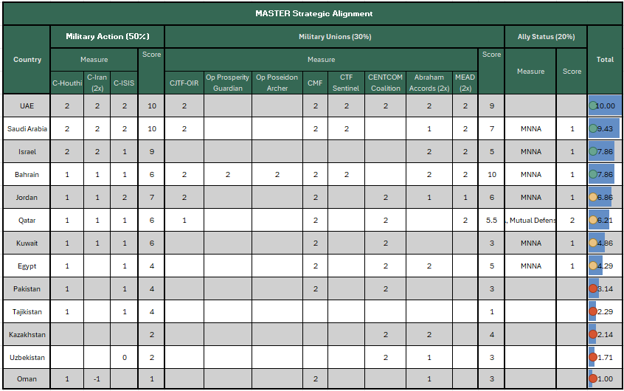
● Strategic Alignment measures employment of military action to support American priorities (50% weight), the breadth and depth of participation in CENTCOM’s eight main coalitions (30% weight), and the nation’s status as a Major Non-NATO Ally (20% weight). Points are granted on a 1-10 scale as a summation of all categories.
o Military Action (50% weight) against ISIS, the Houthis, and Iran (weighted 2x due to strategic significance), inform a nation’s willingness to participate in American national defense priorities. Points are granted as 0, 1, or 2, based on level of engagement. A score of two denotes active military engagement, a single point describes only diplomatic or public support of military action, and zero points are granted to countries who provide no military or diplomatic support. In Oman’s rare case, negative points are granted because of Oman’s condemnation of American action against the Iranian Regime in 2025[xli] and 2026[xlii].
o Military Unions (30% weight) measures each country’s involvement in America’s eight key coalitions—CJTF-OIR, Operation Prosperity Guardian, Operation Poseidon Archer, the Combined Maritime Forces (CMF), CTF Sentinel, the CENTCOM Coalition, MEAD (weighted at 2x) and the Abraham Accords (weighted at 2x). MEAD and the Abraham Accords are double-weighted due to their outsized positive military impact to defense of American assets in CENTCOM[xliii] and the significant political implications of accepting the Accords[xliv], respectively.
o Ally Status (20% weight) grants points as 0, 1, or 2, based on Major non-NATO Ally (MNNA) status. MNNA partners are granted 1 point, with Qatar receiving 2 points as the only nation in the Middle East to have both a Mutual Defense Pact and Main non-NATO Ally status with the United States.
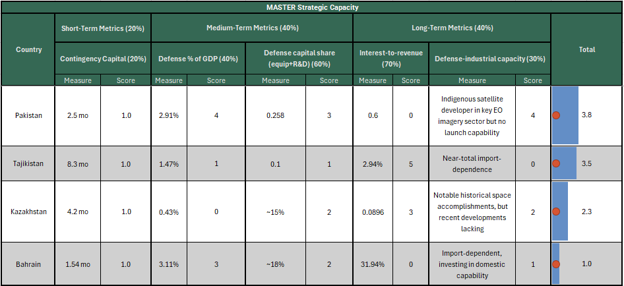
Strategic Capacity – 25% Weight.
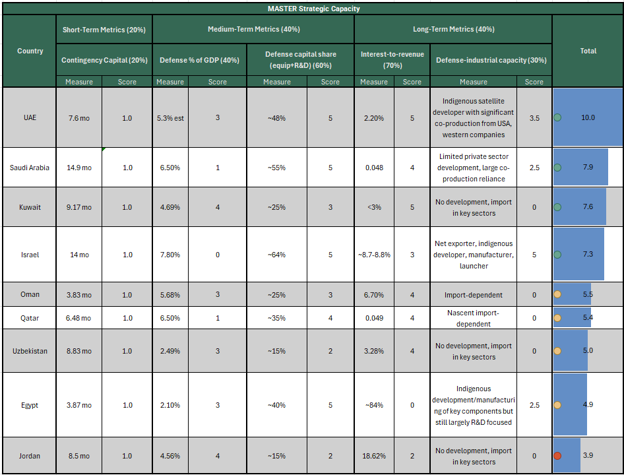
● Strategic Capacity evaluates short-term, medium-term, and long-term economic metrics to understand a nation’s capacity for system development, sustainment, and employment.
● Short-Term Metrics – 20% weight. Short-term metrics define a nation’s immediate ability to support partnership with the Space Force. Because of the longer-term nature of space development, short-term metrics are weighted as a lower portion of the overall Strategic Capacity valuation.
o Contingency capital measures the number of months a country can rely on its own foreign capital reserves to pay for imports necessary for national defense and economic sustainment. Import Cover Ratio is employed to inform this variable.
● Mid-Term Metrics – 40% weight. Constellation-sized investments such as PWSA take time to develop. While these systems could become fully operational in a few years, they certainly won’t come online in a matter of months. Therefore, like-minded variables should be used to value a nation’s mid-term capacity. In this case, defense percentage of GDP (40% weight) and defense capital share (60% weight)—a measure of defense expenditure on equipment & R&D versus pension payment and troop sustainment—are used to inform a nation’s mid-term investment capacity.
o Defense Percentage of GDP (40% weight) is measured as a bell-curve, with the peak being between 3 and 4% and the troughs being below 1% and above 7%. Although a significant defense percentage of GDP may seem militarily advantageous, it isn’t strategically beneficial[xlv], [xlvi]. Further, too little defense percentage of GDP is an immediate red flag that signals low military capability. Points are granted as a range between 0 and 5, with the maximum score being sourced from America’s traditional defense percent of GDP and NATO’s GDP obligation:
▪ >7% = 0
▪ 6.5-7% = 1
▪ 6-6.5% = 2
▪ 5-6% = 3
▪ 4-5% = 4
▪ 3-4% = 5
▪ 3-2.5% = 4
▪ 2.5-2% = 3
▪ 2-1.5%= 2
▪ 1.5-1% = 1
▪ <1% = 0
o Defense capital share (60% weight) measures what percentage of a nation’s defense budget is spent on investments in military capability. Points are granted within a 0–5 point range according to expenditure category percentages:
▪ <10% on equipment/R&D = 0
▪ 10-15% on equipment/R&D = 1
▪ 15-20% on equipment/R&D = 2
▪ 20-30% on equipment/R&D = 3
▪ 30-40% on equipment/R&D = 4
▪ 40-50% on equipment/R&D = 5
● Long Term Metrics – 40% weight. These categories highlight those countries with the best economic standing to support decade-and-beyond partnership. Big-ticket items such as space launch centers and full-scope satellite constellations demand significant investments in infrastructure, equipment, and personnel; all of which require competitive interest-to-revenue (70% weight) ratio and adequate defense-industrial capacity (30% weight).
o Interest-to-revenue (70% weight) explains how much of a nation’s overall budget is committed to debt servicing. Points are granted on a 0-5 range based on percentage:
▪ >30% = 0
▪ 20-30% = 1
▪ 12-20% = 2
▪ 7-12% = 3
▪ 3-7% = 4
▪ <3% = 5
o Defense-industrial capacity (30% weight) is a qualitative measure used to analyze a nation’s ability to produce key space components from within their borders. Five categories of capability are prescribed, ranging from completely import-dependent to full-spectrum manufacturer and equipment exporter. Points are likewise granted on a 0-5 range:
▪ import-dependent = 0
▪ minor assembly/maintenance = 1
▪ limited components = 2
▪ notable co-production = 3
▪ indigenous design in key sectors = 4
▪ full spectrum manufacturer, developer, net exporter = 5
Complete Weighted Rankings – Overall Scores
Strategic Utility
Strategic Alignment
Strategic Capacity
Building Alliances for the Future – Israel, Saudi Arabia, and the United Arab Emirates
Unsurprisingly, the Sand to Stars Framework illuminates Israel as the region’s most combat-capable space partner, with indigenous space launch vehicles, launch sites, on-orbit sensing technologies, and its own space-focused military units proven in combat. However, the framework also spotlights Israel’s benign cooperation with the United States in other priority areas, reframing this space-forward nation as a reliable defense partner only when dealing with Iran and its aligned militia groups. Saudi Arabia stands out as a jack-of-all-trades contender, placing well in all categories to secure the overall second place. Unexpectedly, the UAE excels past all other nations—including Saudi Arabia—in the Strategic Capacity metric, clearly stating its advanced technological and economic capability to support long-term Space Force partnership.
Israel
The IDF’s space-enabled domination[xlvii],[xlviii] of Iran’s forces during both MIDNIGHT HAMMER and EPIC FURY illustrate an exquisite ability to integrate the space domain to achieve key objectives. However, Israel does suffer from two concerning metrics. The war-postured nation has a Defense Percent of GDP of 7.8%, the highest in the Middle East and an uncomfortably large share of economic production. Further, outside of its operations against Iran and the Houthis, Israel isn’t a major player in America’s other regional interests, such as counter-narcotics and counter-smuggling operations. Although Israel may be America’s best ally against Iran, the Space Force shouldn’t count on Israel to support its greater defense objectives in the Middle East.
Instead of focusing on long-term development, the Space Force should evolve bilateral defense cooperation and expand space-based defense initiatives via the inbound Space Based Sensing and Targeting (SBST)[xlix] surveillance and monitoring platform. First, Israel should be invited to participate in USSPACECOM’s multi-national exercises OLYMPIC DEFENDER[l] and GLOBAL SENTINEL[li], where the combat-tested nation could establish itself as the first Middle Eastern SPACECOM partner. Then, collection lease agreements of the Space Force’s upcoming SBST constellation[lii], [liii] between the IDF and the Department of War could enhance battlespace awareness, offload analytic burden, and thwart strategic surprise in the Middle East as national defense priorities shift towards the pacific[liv].
Saudi Arabia
A wholistically competitive partner, Saudi Arabia boasts an impressive short-term capacity ranking and notable link-segment potential. With a contingency capital score of 14.9 months, low EMI and Danger Co-efficient rankings, and high spot-beam exposure at both Prince Sultan AB and King Faisal AB, the Kingdom is the definition of a reliable wartime partner with strong financial reserves. Space Force investors should leverage Saudi’s optimal geography to jointly operate SEW intelligence platforms and weapon systems. By focusing on Gen Saltzman’s International Partnership LOE #2, Integrate[lv], the Space Force can work to evolve Saudi Arabia into an exceptional partner supporting Space Force operations in peacetime and during a crisis scenario.
To expand partner capability, SPACECENT should relocate its Space Campus and SEW weapon systems from Qatar to Saudi Arabia. Institutionalized as a subcomponent of Air Forces – CENTRAL[lvi], space forces in the Middle East have yet to break from their Air Force roots and transition command and control from Qatar to a location more beneficial to theater space operations. If the DoW is truly re-evaluating basing decisions around the Arabian Gulf as insiders claim[lvii], then SPACECENT should advocate for its forces to find a new home at Prince Sultan Air Base, where SPACECENT will benefit from robust protection measures, optimal spot-beam exposure, a reliable military partner, and an advantageous latitude. To support these jointly operated weapon systems, the Space Force should follow the example set by the U.S. Air Force F-15 training school in Idaho[lviii] or the International Intelligence Training Center[lix] in San Angelo, TX to establish its own in-theater space academy in Saudi Arabia, where the warfighting trades of electromagnetic warfare, missile warning, and space operations will be taught and mastered. Where Qatar’s training academy in Idaho benefits from friendly skies and the intelligence training center in Texas complements the Air Force’s own intelligence education center located at the same installation, a Middle East-based space academy will give Arab operators a permissive environment to hone their skills while training with real-world security problems to practice and master space capabilities. Funded by benefacting nations through International Military Education and Training (IMET)-compliant foreign materiel sale funneled to Space Delta 13, the dean of space education for the Space Force and America’s joint and allied partners[lx], the new space academy should be staffed by a detachment of National Security Space Institute (NSSI) professors permanently based alongside SPACECENT in Tampa, Florida, who can forward-deploy on education campaigns to teach critical space skills.
United Arab Emirates
If mutual priorities and long-term capacity are the defining factors of a strong alliance, then the United Arab Emirates is the Space Force’s Polaris star guiding strategic partnership in the Middle East. The UAE is first-in-class in Strategic Alignment, with signatory status on the Abraham Accords[lxi], likely participation in the Middle East Air Defense (MEAD) alliance [lxii], [lxiii], [lxiv] and observed joint engagement against Iran[lxv], the Houthis[lxvi], and ISIS[lxvii] spotlighting this nation’s strategic partner potential. The UAE boasts best-in-class mid- and long-term economic metrics, a ranking earned by its indigenous development of key space components[lxviii], co-development of space technology[lxix] with America, and a competitive Defense Capital Share.
While the UAE’s proximity to Iran inhibits smart ground- and link-segment investment, on-orbit partnership with the UAE can enable mission success on key Space Force objectives. Investment with the UAE should emphasize constellation co-development and integration into orbital warfare plans, with NRO partnerships such as that with Australia[lxx] setting the example for future opportunities.
Conclusion
As our Arab partners build space capabilities, the U.S. Space Force can provide the essential knowledge and technological access required to ensure space security and mission assurance for these immensely important national assets. In kind, investment in the Middle East will grant the U.S. Space Force unprecedented access to a region of the world otherwise denied to space networking, ensuring the future of our next-generation systems and prohibiting China from uprooting longstanding American alliances. By employing the Sand to Stars Investment Framework and actioning the immediate opportunities outlined above, the U.S. Space Force can ensure it’s always above, across the globe.
[i] U.S. Central Command. “Statement before the Senate Committee on Armed Services on the Posture of United States Central Command.” U.S. Central Command, 2026. https://www.centcom.mil/ABOUT-US/SASC-POSTURE-STATEMENT-2026/
[ii] Mathews, Sean. “ ‘Vulnerability Exposed’: War on Iran Will Change How the US Bases Troops in Gulf.” Middle East Eye, June 8, 2026. https://www.middleeasteye.net/news/vulnerability-exposed-war-iran-will-change-how-us-bases-troops-gulf
[iii] Golf, Barbara. “Joint Commercial Operations (JCO) Introduction and Way Forward” Paper presented at the Advanced Maui Optical and Space Surveillance Technologies Conference, 2024. https://amostech.com/TechnicalPapers/2024/Featured/Golf.pdf
[iv] Erwin, Sandra. “US, Close Allies Creating Joint Orbital Warfare Plan, SPACECOM Chief Says.” Breaking Defense, May 2026. https://breakingdefense.com/2026/05/us-close-allies-creating-joint-orbital-warfare-plan-spacecom-chief/
[v] U.S. Space Force. Objective Force Design 2040: Baseline. 2026. https://www.spaceforce.mil/Portals/2/Documents/SAF_2026/OFD_2040_Baseline_Final.pdf
[vi] U.S. Space Force. Objective Force Design 2040: Baseline. 2026. https://www.spaceforce.mil/Portals/2/Documents/SAF_2026/OFD_2040_Baseline_Final.pdf
[vii] Bonnal, Christophe. “The Proliferation of Space Debris in the Earth’s Orbit.” Polytechnique Insights, February 12, 2025. https://www.polytechnique-insights.com/en/columns/space/the-proliferation-of-space-debris-in-the-earths-orbit/
[viii] Wilson, Cynthia, and Diana McKissock. “18 SDS Small Satellite Support.” Paper presented at the 2022 Small Satellite Conference, Logan, UT, August 2022. https://digitalcommons.usu.edu/smallsat/2022/all2022/124/
[ix] NSE Staff. “What Is the Space Silk Road, and Why Is It Important?” New Space Economy, October 17, 2025. https://newspaceeconomy.ca/2025/10/17/what-is-the-space-silk-road-and-why-is-it-important/
[x] Wilson, J.R. “Satellite Communication Key to Victory in Iraq.” Military & Aerospace Electronics, August 1, 2003. https://www.militaryaerospace.com/home/article/16709259/satellite-communication-key-to-victory-in-iraq.
[xi] Holmes, Mark. “Demand, Challenges and Satellite in Afghanistan—From Our Archives.” Via Satellite, August 24, 2017. https://www.satellitetoday.com/connectivity/2017/08/24/demand-challenges-satellite-afghanistan-archives/.
[xii] SpaceX. “Starshield.” Accessed August 23, 2026. https://www.spacex.com/starshield
[xiii] Hitchens, Theresa. “Space Force Shifts from SDA Transport Layer to New Space Data Network Backbone for Orbital Relay.” Breaking Defense, April 2026. https://breakingdefense.com/2026/04/space-force-shifts-from-sda-transport-layer-to-new-space-data-network-backbone-for-orbital-relay/
[xiv] Albon, Courtney. “SPACECOM Wants to Proliferate Ground Stations—and Counter Adversary Proliferation.” Air & Space Forces Magazine, August 13, 2026.
[xv] Erwin, Sandra. “SDA Eyes Commercial Capabilities, Services for Future Ground Segment Operations.” DefenseScoop, April 23, 2024. https://defensescoop.com/2024/04/23/sda-commercial-capabilities-services-ground-segment-operations/
[xvi] 162nd Wing Public Affairs, “AATC tests enhanced intelligence gathering capabilities with MQ-9 Reaper upgrade,” AATC, May 27, 2023, https://www.af.mil/News/Article-Display/Article/3406025/aatc-tests-enhanced-intelligence-gathering-capabilities-with-mq-9-reaper-upgrade/
[xvii] Starlink Insider. “Starlink Gateway Locations.” Starlink Insider. Accessed August 23, 2026. https://starlinkinsider.com/starlink-gateway-locations/
[xviii] Aizaz U. Chaudhry and Halim Yanikomeroglu. “Laser Inter-Satellite Links in a Starlink Constellation,” , Carleton University. Accessed August 23, 2026. chrome-extension://efaidnbmnnnibpcajpcglclefindmkaj/https://arxiv.org/pdf/2103.00056
[xix] Telesat, “A New Level of Secure Satellite Gateways for Government Users,” The Critical Link, June 11, 2024, https://www.telesat.com/blog/a-new-level-of-secure-satellite-gateways-for-government-users/
[xx] Starlink, “Network Update,” Starlink, n.d., retrieved October 29, 2025, https://www.starlink.com/updates/network-update
[xxi] Dishy Central, “Starlink Ground Station Locations: Connecting People Everywhere,” Dishy Central, n.d., retrieved October 29, 2025, https://dishycentral.com/starlink-ground-station-locations/#:~:text=Starlink%20ground%20stations%20are%20key,stations%20help%20connect%20people%20everywhere
[xxii] Cynthia Wilson, Diana McKissock, “18 SDS Small Satellite Support,” U.S. U.S. Space Force 18th Space Defense Squadron, n.d., retrieved November 3, 2025
[xxiii] Wilson, Cynthia. “SSC22-XI-03 Slides.” 2022 Small Satellite Conference. Utah State University Digital Commons. https://digitalcommons.usu.edu/cgi/viewcontent.cgi?filename=0&article=5283&context=smallsat&type=additional
[xxiv] U.S. Space Force. “PAVE PAWS Radar System.” Accessed August 23, 2026. https://www.spaceforce.mil/About-Us/Fact-Sheets/Article/2197752/pave-paws-radar-system/
[xxv] U.S. Space Force. “RAF Fylingdales Maintains around-the-Clock Missile Warning Capability for Both Nations.” Peterson-Schriever Garrison, U.S. Space Force. Accessed August 23, 2026. https://www.petersonschriever.spaceforce.mil/Newsroom/News/Display/Article/733505/raf-fylingdales-maintains-around-the-clock-missile-warning-capability-for-both/
[xxvi] Harvey, Brian. “Iran’s Ascent as a Space Power in the Shadow of Sanctions.” ROOM Space Journal. Accessed August 23, 2026. https://room.eu.com/article/irans-ascent-a-space-power-in-the-shadow-of-sanctions
[xxvii] Etlaq, “Spaceport,” Etlaq, n.d., https://www.etlaq.om/spaceport
[xxviii] Chinese University of Hong Kong (CUHK), “CUHK ISEIS Allied with Space Silk Road to Enhance Global Satellite Service,” CUHK Communications and Public Relations Office, November 9, 2014, https://www.cpr.cuhk.edu.hk/en/press/cuhk-iseis-allied-with-space-silk-road-to-enhance-global-satellite-service/
[xxix] Krebs, Gunter D. “Satellites of Pakistan”. Gunter’s Space Page, n.d., retrieved October 29, 2025, https://space.skyrocket.de/directories/sat_c_pakistan.htm
[xxx] Jemima Baar, “Beidou and Strategic Advancements in PRC Space Navigation,” Jamestown Foundation, March 1, 2024, https://jamestown.org/program/beidou-and-strategic-advancements-in-prc-space-navigation/
[xxxi] Kartik Bommakanti, “The collusive threat: Chinese and Pakistani cooperation in strategic capabilities,” Observer Research Foundation, June 13, 2023, https://www.orfonline.org/expert-speak/the-collusive-threat
[xxxii] CGTN, “Egyptian space city a model for cooperation with China,” CGTN, April 23, 2025, https://news.cgtn.com/news/2025-04-23/Egyptian-space-city-a-model-for-cooperation-with-China-1CNGHbxPY1W/p.html
[xxxiii] Pons, Juan. “Egypt Already Has Its Fourth Spy Satellite in Orbit, and the Emirates Its Second Astronaut.” Atalayar, March 4, 2023. https://www.atalayar.com/en/articulo/new-technologies-innovation/egypt-already-has-its-fourth-spy-satellite-orbit-and-emirates-its-second-astronaut/20230304104404182042.html
[xxxiv] CGTN, “Space Development: MisrSat-2 Opens New Chapter for China-Africa Cooperation,” transcript, December 4, 2023, https://news.cgtn.com/news/2023-12-04/VHJhbnNjcmlwdDc2Mjg3/index.html
[xxxv] Andrew Jones, “China loses UAE as partner for Chang’e-7 lunar south pole mission,” SpaceNews, March 24, 2023, https://spacenews.com/china-loses-uae-as-partner-for-change-7-lunar-south-pole-mission/
[xxxvi] Firefly Aerospace, “Firefly Aerospace Adds UAE’s Rashid 2 Rover to Blue Ghost Mission to the Far Side of the Moon,” Firefly Aerospace, n.d., retrieved October 29. 2025, https://fireflyspace.com/news/firefly-aerospace-adds-uaes-rashid-2-rover-to-blue-ghost-mission-to-the-far-side-of-the-moon/
[xxxvii] Congressional Research Service. R48123. Accessed August 23, 2026. https://www.congress.gov/crs-product/R48123
[xxxviii] Shoval, Lilach. “US Weighs Long-Term Military Presence in Israel.” Jewish News Syndicate. Accessed August 23, 2026. https://www.jns.org/news/u-s-news/us-weighs-long-term-military-presence-in-israel
[xxxix] Pezzulli, Bepi. “The Case for a Permanent U.S. Base in Israel.” Times of Israel Blogs. Accessed August 23, 2026. https://blogs.timesofisrael.com/the-case-for-a-permanent-u-s-base-in-israel/.
[xl] TOI Staff. “US Considering Moving Gulf Bases Hit by Iran Westward, Including to Israel: Report.” Times of Israel. Accessed August 23, 2026. https://www.timesofisrael.com/us-considering-moving-gulf-bases-hit-by-iran-westward-including-to-israel-report/
[xli] Ministry of Foreign Affairs, Sultanate of Oman. “سلطنة عُمان تُعرب عن بالغ القلق والاستنكار إزاء التصعيد الناجم عن القصف الذي شنته أمريكا على إيران”
Accessed August 23, 2026. https://www.fm.gov.om/ar/25829/
[xlii] Ministry of Foreign Affairs, Sultanate of Oman. “سلطنة عمان تأسف للعمليات العسكرية التي تشنها إسرائيل والولايات المتحدة ضد إيران” Accessed August 23, 2026. https://www.fm.gov.om/ar/38105/
[xliii] S, Bechu “How US Air Defence Protects the UAE, Kuwait and Other Gulf States from Iranian Ballistic Missiles—Explained.” The Week, March 4, 2026. https://www.theweek.in/news/defence/2026/03/04/how-us-air-defence-protects-the-uae-kuwait-and-other-gulf-states-from-iranian-ballistic-missiles-explained.html
[xliv] Norlen, Tova, and Tamir Sinai. “The Abraham Accords: Paradigm Shift or Realpolitik?” George C. Marshall European Center for Security Studies. Accessed August 23, 2026. https://www.marshallcenter.org/en/publications/security-insights/abraham-accords-paradigm-shift-or-realpolitik
[xlv] Sharp, Travis. “Tying US Defense Spending to GDP: Bad Logic, Bad Policy.” Parameters 38, no. 3 (Autumn 2008): Article 16. U.S. Army War College Press. https://doi.org/10.55540/0031-1723.2443. Accessed August 23, 2026
[xlvi] Hartung, William D. “Spending 5% of GDP on Military Now Would Be Absolutely Devastating.” Responsible Statecraft, January 2025. Accessed August 23, 2026. https://responsiblestatecraft.org/us-increase-defense-spending/
[xlvii] Kahana, Ariel. “Israel Believes Iran Lost a Critical Wartime Capability.” Israel Hayom, April 10, 2026. https://www.israelhayom.com/2026/04/10/israel-believes-iran-lost-a-critical-wartime-capability/
[xlviii] Ahronheim, Anna. “Israel Prepares New Space ‘Surprises’ for Iran War.” Jerusalem Post. Accessed August 23, 2026. https://www.jpost.com/defense-and-tech/article-885413
[xlix] Donald C. Case, “SpaceX to Launch USSF-432 Tuesday, Advancing Space Force Aircraft-Tracking Mesh,” Tech Times, November 1, 2026, https://www.techtimes.com/articles/329832/20261101/spacex-launch-ussf-432-tuesday-advancing-space-force-aircraft-tracking-mesh.htm
[l] U.S. Space Command. “Multinational Force: Operation Olympic Defender.” Accessed August 23, 2026. https://www.spacecom.mil/About/Multinational-Force-Operation-Olympic-Defender/
[li] U.S. Space Command. “U.S. Space Command Hosts Global Sentinel 2025 Exercise.” Accessed August 23, 2026. https://www.spacecom.mil/Newsroom/News/Article-Display/Article/4172892/us-space-command-hosts-global-sentinel-2025-exercise/
[lii] U.S. Space Force. “Securing the Ultimate High Ground: How the Space Force Is Revolutionizing Airborne [Operations].” Accessed August 23, 2026. https://www.spaceforce.mil/News/Article-Display/Article/4471347/securing-the-ultimate-high-ground-how-the-space-force-is-revolutionizing-airbor/
[liii] Whitaker, James. “Space Force Awarded SpaceX All 18 SBST Missions; Golden Dome Has One Launch Provider.” Tech Times, July 30, 2026. https://www.techtimes.com/articles/322186/20260730/space-force-awarded-spacex-all-18-sbst-missions-golden-dome-has-one-launch-provider.htm
[liv] Department of War. “2026NDS—National Defense Strategy—Restoring Peace Through Strength for a New Golden Age of America”. Accessed September 21, 2026.
[lv] United States Space Force. “International Partnership Strategy (2025),” United States Space Force. Accessed November 14, 2026. https://www.spaceforce.mil/Portals/2/Documents/SAF_2025/USSF%20International%20Partnership%20Strategy.pdf.
[lvi] Brian Ferguson, “Airmen in Qatar Become First Deployed Members of the Space Force,” Stars and Stripes, September 9, 2020, https://www.stripes.com/branches/space_force/airmen-in-qatar-become-first-deployed-members-of-the-space-force-1.644371.
[lvii] Anika Arona Seth, Shelby Holliday, Denise Blostein, and Milan Czerny. “How Iran Devastated an American Naval Base—and Caused a U.S. Recalculation.” Wall Street Journal. Accessed August 23, 2026. https://www.wsj.com/world/middle-east/iran-us-naval-base-bahrain-e87bbca3
[lviii] Boone, Rebecca. “Things to Know about the Qatar Training Facility Planned for an Idaho Air Force Base.” AP News, October 10, 2025. https://apnews.com/article/idaho-qatar-us-air-force-base-fc1506584e7833dbde3e16fe8613b6b4.
[lix] Goodfellow Air Force Base, “International Intelligence Training Center (IITC),” accessed November 14, 2026, https://www.goodfellow.af.mil/about-us/fact-sheets/display/article/4270449/international-intelligence-training-center-iitc/.
[lx] Space Training and Readiness Command, “Space Delta 13 - Education,” Space Training and Readiness Command. Accessed November 14, 2026, https://www.starcom.spaceforce.mil/About-Us/Units/Space-Delta-13-Education/.
[lxi] Middle East Institute. “The Abraham Accords.” Accessed August 23, 2026. https://mei.edu/backgrounder/abraham-accords/
[lxii] Schaer, Cathrin. “Who Will Win as New Alliances Emerge in Middle East?” Deutsche Welle. Accessed August 23, 2026. https://www.dw.com/en/who-will-win-as-new-alliances-emerge-in-middle-east/a-77246663
[lxiii] StrategyPage. “Middle East Air Defense Alliance.” StrategyPage, June 30, 2022. https://www.strategypage.com/htmw/htada/articles/20220630.aspx
[lxiv] Hussain Naqvi, Syed Fraz. “Could a Middle East Air Defense Alliance Backfire?” The National Interest. Accessed August 23, 2026. https://nationalinterest.org/blog/lebanon-watch/could-middle-east-air-defense-alliance-backfire-203914
[lxv] Said, Summer and Holliday, Shelby. “The U.A.E. Has Been Secretly Carrying Out Attacks on Iran.” Wall Street Journal. Accessed August 23, 2026. https://www.wsj.com/articles/the-u-a-e-has-been-secretly-carrying-out-attacks-on-iran-f1745a0d
[lxvi] Ghobari, Mohammed. “UAE-Backed Forces Press Yemen’s Marib despite Houthi Warnings.” Reuters, January 25, 2022. https://www.reuters.com/world/middle-east/uae-backed-forces-press-yemens-marib-despite-houthi-warnings-2022-01-25/
[lxvii] MLT Staff. “Arab Coalition Intensifies Attacks on ISIS as UAE Rejoins Fight.” Military.com, February 9, 2015. https://www.military.com/daily-news/2015/02/09/arab-coalition-intensifies-attacks-on-isis-as-uae-rejoins-fight.html
[lxviii] UAE Space Agency. “UAE: Shaping the Future of Earth Observation Satellites and Space Exploration.” March 2, 2020. https://www.space.gov.ae/en/media-center/blogs/2/3/2020/uae-shaping-future-of-earth-observation-satellites-and-space-exploration
[lxix] UAE USA United. “UAE-US Space Exploration.” UAE USA United. Accessed August 23, 2026. https://www.uaeusaunited.com/uae-us-space-exploration
[lxx] Erwin, Sandra. “With Latest Rocket Lab Launch, NRO and Australia Strengthen Allied Cooperation.” Breaking Defense, July 2022. https://breakingdefense.com/2022/07/with-latest-rocket-lab-launch-nro-and-australia-strengthen-allied-cooperation/
