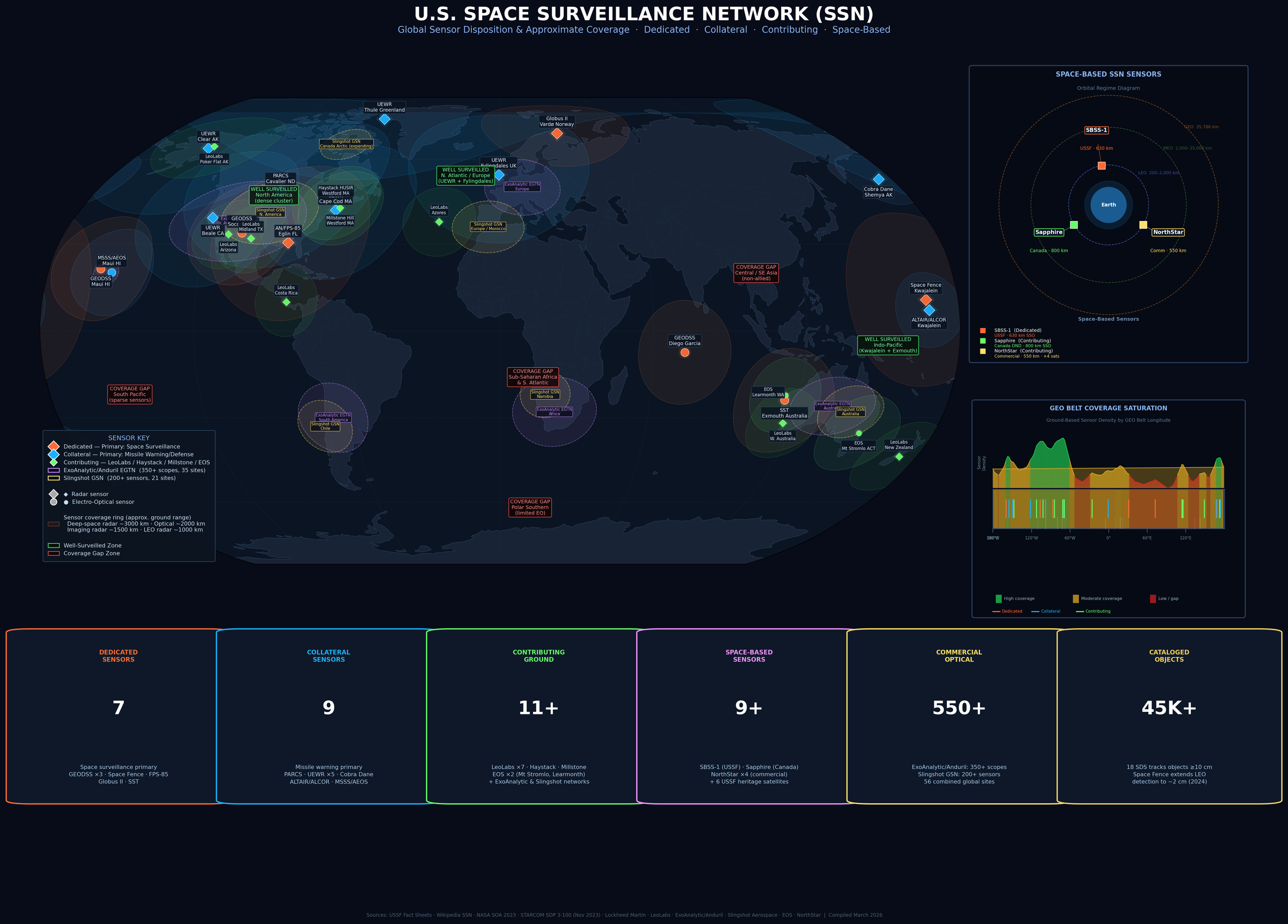
The problem is clear. With an anticipated global total of 100,000 satellites in orbit by 2030, the mission of the Space Force will soon become exponentially more complex in a domain ever more congested. As private and public sector endeavors venture to the Moon and beyond, the Space Force’s capabilities will be tested as a sensor network tuned for precision races to track a parabolic increase of new space objects and debris. To monitor and dominate threats in tomorrow’s space domain, the Nation’s youngest military branch must integrate with the private sector to combat its most monumental challenges.
The Private Eye
In April 2026, I found myself sitting in a window-lit back office just across the highway from the National Space Intelligence Center in Dayton, Ohio. This Center, home to America’s leading space intelligence analysts, is where compelling assessments on space threats are generated to inform our nation’s decision makers. Yet in front of me, in the unclassified office across the street, was equally compelling commercially collected evidence that Russia had launched six undisclosed satellites into orbit, using never-before-seen maneuver techniques to flank Allied and American assets in space. Through its own capabilities, this private company successfully detected, collected, analyzed, and disseminated intelligence that exposed the adversary threat much faster than conventional military timelines. Six months later, in October 2026, space tracking company LeoLabs surveilled one of the six Russian satellites as it sprinted from its flanking position hundreds of kilometers away to a stalking post just 500 meters behind ICEYE-X36, an imagery satellite whose images may be assisting Ukrainian operations against Russia. Today, commercial entities field world-spanning sensor networks that accurately surveil space assets to an extent never seen outside the halls of government. With so many unique opportunities and challenges in the space domain, how will the Space Force utilize this new reality?
The Space Force, alongside organizations such as the National Space Intelligence Center, control the planet’s most exquisite space surveillance systems and produce incredible intelligence with decades of high-profile success to show for it. While the government revolutionizes the next highly precise surveillance sensors, the private sector has proliferated “good-enough” tracking solutions across the globe, enabling companies such as LeoLabs, Anduril, SpaceX, and Slingshot to detect and track threats that emerge in Space Force blind spots. The new reality of space warfare and private sector capability is here—how will the Space Force react?
The Space Surveillance Network (SSN), operated by the Space Force’s 18th and 19th Space Defense Squadrons, is a global architecture of scientific, military, and experimental telescopes that serves as a shining example of American international partnership. While space situational awareness data from the SSN is recognized as the global standard for orbital safety, the commercial sector is exceptionally more equipped to handle the routine monitoring required for assured space situational awareness in the modern age. The Network’s origin as a Soviet satellite tracking apparatus mean its ability to surveil northern latitudes—where Soviet Intercontinental Ballistic Missiles laid in wait and Sputnik operated—is much more robust than its coverage in space-developing regions such as the Middle East, South America, and Africa. Satellite constellations are proliferating across low earth orbit, but SSN surveillance capabilities have not kept pace. For example, on June 26, 2024, an unexpected low-intensity explosion onboard the Russian RESURS-P1 imagery satellite caused its break-up into 180 pieces of scattered debris. As astronauts aboard the International Space Station hurried into lifeboat capsules, three different organizations—LeoLabs, NASA’s Orbital Debris Program Office, and the Space Force—rushed to provide an assessment. LeoLabs, the private space company, beat both government agencies by about nine hours, providing immediate safety data to the astronauts and preventing further disruption to orbital operations. LeoLabs didn’t outperform its government counterparts because its sensors are more capable; it beat the government because it owns more sensors in regions that matter. Companies like LeoLabs, Anduril, Slingshot, and even SpaceX all operate their own space situational awareness architectures across these regions to serve both government and commercial space operators. The private sector is rapidly fielding capabilities the Space Force can employ to overpower and outmatch the ever-increasing complexity of orbital space safety.
Built for the Average Astronaut
Still, valid concerns arise when integrating space situational awareness missions with commercial entities. Documented incidents show that conflicts of interest arise when commercial space operators are also responsible for providing updates on their systems’ activities. For instance, when Virgin Galactic carried Richard Branson on a suborbital flight aboard its VSS Unity spaceplane, the FAA “found Virgin Galactic failed to communicate [flight] deviations” to the regulator as directed by law. In space, unreported deviations cause catastrophes, as explained by a SpaceX statement outlining its reason for developing Stargaze. Further, commercial sensing capabilities aren’t nearly as advanced as government sensors, meaning some dangerous space objects could go unnoticed if their monitoring were to be completely delegated to the private sector. Even LeoLabs, the private sector’s best offering for precise surveillance, is only capable of reliably tracking objects 10 centimeters in size or larger; five times less precise than the Space Force’s best offering.
However, all these concerns can be negated with an established civil-military space surveillance framework. By establishing a multi-source, multi-class commercial data layer integrated into the current SSN three-tiered sensor disposition, shortcomings of any one private company will be overcome by the observations of several others. Current Space Force licensing agreements with LeoLabs, for example, are vulnerable to data blind spots. To combat this, the Space Force needs similar agreements with surveillance companies across the sector to build a resilient sensor layer that is fully integrated into the SSN. By evolving the Joint Commercial Operations activity into a stand-alone Center, the Space Force can develop the required licensing agreements, closing unnecessary blind spots with multiple commercial sensors integrated into the Space Force’s operational picture of each orbital regime. In addition to establishing this surveillance framework and related licensing agreements, the Space Force can further optimize its capabilities through a renewed focus on strategic military objectives. To this end, the recently established TraCCS platform under the Department of Commerce offers a promising way ahead for all non-defense related space situational awareness missions. By partnering with the Department of Commerce, the Space Force can redirect all non-military space situational awareness obligations away from its most advanced sensors, ensuring the Space Force’s advanced capabilities have the bandwidth to catch and catalogue those objects too sensitive for private sensors.
A key objective of the USSF is space control, and situational awareness is an absolute necessity to achieve this objective. But maintaining catalogue maintenance for the world’s space traffic control system isn’t a burden the Space Force should carry. In the same way the Bureau of Air Commerce took custody for air traffic control at the dawn of flight, the Space Force must delegate non-military space situational awareness to the commercial sector and Department of Commerce, ensuring Space Force Guardians are only focused on those satellites relating to its key objectives.
Refining the Space Force Mission
Although revolutionizing the decades-old SSN may seem like a large enough task, it represents just a small portion of the gargantuan mission by which the Space Force is charged. As a hybrid between the domestically-focused Coast Guard and the war-postured Navy, the Space Force mission simultaneously includes requirements to prepare for combat on orbit while also facilitating economic prosperity through space access. With a force size of roughly 1/40th the Coast Guard and Navy with just one-quarter of their budget, the Space Force is spreading its money and manpower hazardously thin. This is unwise and unsustainable – the Force must focus. By fusing the private sector into its operations, the Space Force can refine its mission to those areas most pertinent to national defense and delegate its economic security missions to the companies and other government agencies most suited to complete them.
In fact, the Space Force can follow the lead of the US Coast Guard, which has implemented an entire Navigation Center (NAVCEN) to similarly refine the Service mission. Dedicated to defending critical American infrastructure, NAVCEN operates as a sentry for the homeland, promoting American commerce, ensuring freedom of movement, and defending the maritime environment around key American port infrastructure. Instead of monitoring vessels across the world for threats to American ports, NAVCEN only monitors vessels closest to American waterways and takes action when unsafe events transpire. Right now, Space Force Guardians are working overtime to provide space situational awareness for every satellite and piece of debris in space, when in reality, they should only be focused on the strategically important key terrain, Geosynchronous Orbit longitudes, and, soon, locations around the Moon that will require constant surveillance for the defense of America’s national priorities.
Cementing Assured Space Surveillance
Two conflicting truths present an interesting problem. The Space Force would greatly benefit from delegating surveillance of non-military space objects so it can focus only on those satellites most important to national security. But, as proven by the RESURS-P1 break-up event, any presumably non-threatening satellite can spontaneously become a problem for the most strategic assets in space. To navigate this challenge, the Space Force should implement corporate space data into the fold as a cornerstone of its space surveillance program to both manage catalogue maintenance and provide indications and warnings of potential security threats. This private sector data can provide constant, baseline surveillance of everything in space, and barring issues of national security, be made available to the global space community on TraCCS and space-track.org, the current public-facing Space Force space situational awareness database. Similar to the SSN’s legacy Operation Moonwatch program, the private sector will act as a global space surveillance web, helping point the dedicated military sensors toward the most important space objects and redirecting all other catalogue tasks to non-military capabilities. Enhancing this foundational private sector data will be the Department of War’s global ‘collateral’ and ‘contributing’ sensor network made up of high-fidelity missile warning radars and telescopes used to track satellites during peacetime. With the SSN’s ‘dedicated sensor’ network now unburdened, Guardians themselves can task the Space Force’s most advanced surveillance capabilities to continuously scan for new threats and monitor known space weapons, ensuring emerging and existing warfighting problems always have accurate solutions. Overseeing this fourth layer of the Space Surveillance Network will be the newly minted Joint Commercial Operations Center which, in coordination with the Department of Commerce, will guarantee reliable catalogue maintenance and solidify communications channels to the National Space Defense Center where the Space Surveillance Network delivers intelligence and surveillance insights. In the same way the original Operation Moonwatch program coupled private and public capability together for exceptional space awareness, the Space Force should use this framework to guarantee space superiority for America and her allies.
Conclusion
The future is now. The Space Force cannot wait for 100,000 satellites to overburden the Space Surveillance Network when cracks have already formed along its seams. To fight and win in the final frontier, comprehensive private sector integration is the rocket fuel needed to propel the Space Force toward assured space superiority.
